

An Alberta-specific guide to the slow-burn failure mode that hits Calgary roofs harder than any other prairie city, written by a contractor with 25 years in Chinook country.
Calgary averages 30 to 35 Chinook events per winter. Each one cycles outside temperatures from well below freezing to well above in a matter of hours, sometimes minutes. No other Canadian city this far north sees as much freeze-thaw activity, and almost no other roofing market builds against it the way Calgary contractors have to.
Freeze-thaw damage is the dominant slow-failure mechanism on Calgary roofs after deck rot. It cracks sealants, breaks the bond between shingle courses, opens flashings, and quietly converts a roof from watertight to leak-prone over five or six winters. The damage rarely shows up after a single Chinook. It shows up after the 200th, when something finally gives. This piece walks through the signs, the timing, and what to do before the next cycle hits.
What a Chinook actually does to a roof
A typical Calgary Chinook brings outside air temperatures from around -20°C to +8°C in under 12 hours. That swing happens unevenly across the roof. The south-facing slope warms first and most, the north-facing slope warms last and least, and the ridge and eaves warm at different rates because of different mass and exposure.
Inside that uneven swing, three things happen in sequence. Ice and snow on the warming slope partially melt and refreeze when the temperature drops again that night. Asphalt shingles flex as the temperature crosses the freezing point — the asphalt softens, then stiffens, then softens again. Caulks and sealants expand and contract at rates that differ from the metal flashing they’re sealing to.
Each individual cycle is harmless. The 200th cycle in five years is what breaks things. Sealants harden and crack. Shingle seal strips break their bond. Flashing fasteners back out a fraction of a millimetre per cycle and eventually let water past.
The seven signs of cumulative Chinook damage
Chinook damage is recognizable when you know what to look for. The signature shows up in seven places:
-
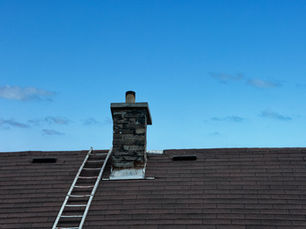
Cracked sealant at chimney counter-flashing, at the top edge of step flashing, and at any reglet joint. The crack is usually a hairline visible only on close inspection.
-
Lifted shingle tabs that no longer seal back down after wind events. The seal strip bond has failed from repeated thermal cycling.
-
Loose nail heads visible on the surface — fasteners that have backed out a small fraction per cycle and now sit proud of the shingle face.
-
Pipe boot collar cracks at the rubber gasket around plumbing stacks. The EPDM rubber loses elasticity after roughly seven years of Chinook cycling and starts to fissure.
-
Granule loss concentrated at the ridge caps and rake edges. These areas see the most temperature variation and the most UV.
-
Ice damming pattern repeatedly forming at the same eave locations. The pattern indicates either inadequate ventilation, inadequate insulation at the soffit edge, or both — both worsened by freeze-thaw flexing.
-
Frost staining on the underside of the deck inside the attic. The freeze-thaw cycle drives moisture into the sheathing and the spring thaw expresses it as visible staining.
Any one of these signs alone is repairable. Three or more on the same roof mean the system is past its Chinook tolerance and a full replacement plan should be on the table within the next two seasons.
Timing — when each fails
Each failure mode has a typical timeline on a Calgary roof. Sealants and caulks at flashing transitions begin to crack around year seven. Pipe boot collars begin to fissure around year eight. Shingle seal strip bonds begin to break around year 10 to 12 on standard 3-tab products, 12 to 15 on architectural laminates. Granule loss accelerates noticeably around year 15. Ice damming patterns develop or worsen whenever ventilation slips below code minimum, independent of roof age.
These numbers shift with shingle quality, install quality, and ventilation. A premium architectural shingle installed with synthetic underlayment and proper attic ventilation on a Class 4 impact-rated product can stretch every number by three to five years. A builder-grade 3-tab with stapled installation and a blocked soffit can compress them by the same.
The timing matters because Chinook damage is cumulative. Once cracks open in the sealant at the chimney counter-flashing, every subsequent Chinook drives water deeper into the wall behind, and the deck and framing damage outpaces the visible roofing damage.
What to do before the next cycle
IIf the roof is showing one or two Chinook signatures and is otherwise in good shape, targeted Calgary roof maintenance buys real life extension. Three repairs done in a clear, dry stretch in spring or fall pay back well.
Re-seal all flashing transitions. A tube of tripolymer sealant and an hour on the roof refreshes the chimney counter-flashing, the step flashing top edge, and the parapet-to-roof joints. Old sealant is cut out, the substrate cleaned, and fresh material applied. Done every five to seven years, this single maintenance task adds five years to most Calgary roofs.
Replace pipe boot collars at year seven or older. A retrofit collar with a new EPDM gasket installs in 20 minutes per stack and prevents the most common single leak point on Calgary homes.
Tighten or replace exposed fasteners with sealant caps. Any nail head that has backed out is re-driven and capped, or replaced with a fresh fastener if the wood has lost holding capacity.
When maintenance stops working
Maintenance buys years, not decades. At some point the cumulative damage exceeds what spot repair can fix, and the right answer is full replacement. The trigger conditions are recognizable:
Three or more Chinook signatures present on the same roof. The system is no longer holding together as a system.
Sealant cracks that have already let water past — usually evidenced by interior staining or attic deck staining downstream of the leak path. Once water has reached the framing, sealant repair is symptomatic, not curative.
Shingle seal strips broken across more than 10 percent of the field. The roof is no longer wind-resistant and the next 90 km/h Chinook event will strip shingles.
Deck staining or frost patterns that have not resolved after ventilation correction. The deck is taking on more moisture each year than it can shed.
Repair cost projection over the next five years exceeding 40 percent of replacement cost. At that point, replacement is more economical and produces a roof with a full design-life ahead of it rather than one fighting its own backlog of accumulated damage.
Specifying the next roof for Chinook country
If the existing roof has hit the replacement point, the specification for the next one should be written specifically for Calgary’s freeze-thaw load. Four spec items matter more here than in milder climates.
Self-adhered ice-and-water membrane at all eaves, valleys, and around penetrations. Minimum 36-inch coverage from the eave edge. The membrane is the second line of defence when shingles fail under Chinook cycling.
Synthetic underlayment across the field rather than 15-pound felt. Synthetic stays intact through wind events and resists tearing when shingles lift, both of which happen more in Chinook country.
Class 4 impact-rated shingles or polymer roofing such as Euroshield. Both products carry better cold-flexibility ratings than standard shingles and stretch the Chinook tolerance of the roof substantially.
Manufacturer-certified install. The warranty on every premium shingle product requires installation to manufacturer specification — fastener placement, ventilation ratios, underlayment overlap. A certified Alberta roofing crew working to manufacturer spec delivers the warranty term advertised. A non-certified install delivers a fraction of it.
Build for the climate you actually have
Most national roofing specifications are written for a milder climate than Calgary actually delivers. A roof spec borrowed from southern Ontario or coastal BC routinely underperforms in Chinook country because it was never designed for 200 freeze-thaw cycles per decade. The Alberta-specific upgrades are not expensive — they add a few percent to the project cost — and they add years to the roof’s service life.
Catch the early signs before they compound. Maintain on a five- to seven-year cycle. Replace when the cumulative damage outruns repair economics. Build the next roof for the climate that’s actually outside the front door. The Chinook isn’t going anywhere, and the Calgary roofs that respect that climate fact are the ones still in good service 30 years later.
About the author — this article was contributed by Superior Roofing Ltd., a Calgary contractor with 25+ years of Chinook-climate roofing experience. The team holds Red Seal Journeyman certification, $10 million in liability coverage, and manufacturer authorizations across SOPREMA, Owens Corning, and Euroshield product lines.