
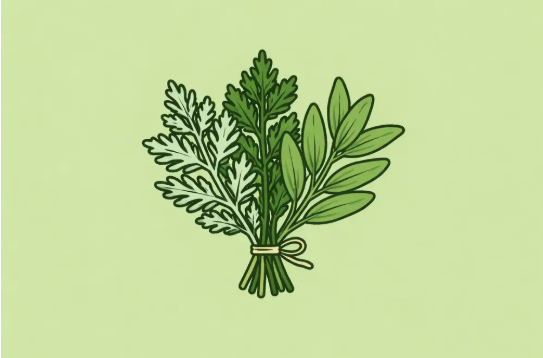

Wormwood vs Mugwort vs Sage: Same Vibe, Very Different Use & Safety
Wormwood vs Mugwort vs Sage sounds like a simple herbal comparison, but the look-alike names can hide real safety differences. Wormwood and mugwort share a genus (Artemisia), while “sage” is usually Salvia, a different plant family entirely. This matters because the chemistry, common preparations (tea vs essential oil), allergy risk, and “do-not-use” groups are not the same. If you want a practical way to tell them apart and reduce avoidable risk, this guide is for you.
- Thujone exposure cap in EU herbal monographs: products should keep daily exposure below 6 mg thujone/day for both wormwood and common sage preparations covered by EMA monographs.
- Mugwort pollen allergy burden: mugwort pollen is a major seasonal allergen in Europe and affects roughly 10–15% of people with pollinosis in some reports.
- Human evidence gap: for mugwort, major public-health resources note very little research in people, so safety and usefulness remain uncertain.
Are wormwood, mugwort, and sage actually the same plant?
No. The confusion usually comes from shared “bitter-herb” reputation, overlapping folk names, and the fact that mugwort is sometimes called “wild wormwood.” Botanically, wormwood is Artemisia absinthium and mugwort is Artemisia vulgaris. They are relatives in the daisy family (Asteraceae). “Sage,” however, usually refers to Salvia species (most commonly Salvia officinalis) in the mint family (Lamiaceae).
That taxonomy difference is not trivia. It predicts different dominant compounds, different allergen profiles, and different typical product formats. Most mix-ups happen at the product level: dried leaf powders, tinctures, “extract drops,” and especially essential oils.
Quick taxonomy snapshot
- Wormwood: Artemisia absinthium (family: Asteraceae)
- Mugwort: Artemisia vulgaris (family: Asteraceae)
- Sage: Salvia officinalis and related Salvia species (family: Lamiaceae)
Why can “same-family vibe” be dangerous?
Similar smell and bitterness can trick you into assuming similar safety. In reality, risk depends on the specific species, the part used, and the preparation. A mild tea is not the same as a concentrated essential oil. And a “sage” product can mean leaf tea, culinary seasoning, alcoholic tincture, or highly concentrated oil—each with a different risk profile.
The biggest “gotcha” chemical here is thujone, a monoterpene found in varying amounts in wormwood and some sages. Thujone is known for neurotoxic potential at high exposures, which is why multiple regulators and monographs address limits. The same compound can be present at trivial levels in food use and much higher levels in essential oils.
The preparation problem: tea vs tincture vs essential oil
People often compare herbs as if the dose is inherently “herbal” and therefore gentle. That assumption fails when you move from traditional infusions to concentrated extracts or oils. For example, EMA documents for wormwood and sage explicitly flag thujone exposure management and reference an upper daily exposure target. In practical terms: concentrated products demand much more caution than culinary or mild tea use.
What are the core differences between wormwood, mugwort, and sage?
| Plant (common name) | Latin name | Family | Typical “everyday” use | Big safety themes |
| Wormwood | Artemisia absinthium | Asteraceae | Bitter herb; historically for appetite/dyspepsia; also famous in absinthe culture | Thujone management; avoid high-dose essential oil use; extra caution in pregnancy and seizure disorders |
| Mugwort | Artemisia vulgaris | Asteraceae | Traditional herb in Europe/Asia; also known for pollen and cross-reactive allergies | Allergy risk (pollen/spice syndromes); limited human evidence; careful sourcing to avoid mislabeling |
| Sage (common sage) | Salvia officinalis | Lamiaceae | Culinary herb; teas; traditional mouth/throat comfort uses | Thujone in some preparations; essential oil ingestion risk (notably in children); pregnancy caution |
Wormwood in one paragraph
Wormwood (Artemisia absinthium) is the archetypal bitter herb. In EU herbal frameworks, it appears as a traditional herbal medicinal product for temporary loss of appetite and mild dyspeptic complaints. Its volatile fraction can contain thujone, and EMA materials emphasize controlling daily thujone exposure in products. For beginners, the simplest safe framing is: wormwood is not a casual “take more for stronger effect” herb, especially in concentrated forms.
Mugwort in one paragraph
Mugwort (Artemisia vulgaris) is often the most misunderstood because it sits at the intersection of “herb” and “allergen.” Major public sources note that human research is limited, so claims about benefits should stay conservative. If you have seasonal allergies (especially late summer/fall in many regions), mugwort pollen sensitization can matter, and cross-reactive food/spice reactions are documented in the allergy literature. This makes mugwort a “check your risk first” herb rather than a default daily tea for everyone.
Sage in one paragraph
“Sage” usually means Salvia officinalis, a culinary staple with a long tradition. Food use is widely considered low risk. The safety conversation changes when you talk about high-dose or long-duration supplementation, and it changes dramatically with sage essential oil. Clinical case reports describe seizures in young children after accidental exposure to sage oil, which is one reason many medical resources warn against high-dose thujone exposure.
How do you avoid misidentification and label confusion?
Confusion is common because these names travel across languages and product categories. “Mugwort” can be sold as “wild wormwood.” “Sage” can mean dozens of Salvia species, and “white sage” is a different plant than culinary sage. Here is a practical, low-drama way to reduce mistakes.
Label-reading rules that actually work
- Require the Latin binomial on the label: Artemisia absinthium vs Artemisia vulgaris vs Salvia officinalis.
- Identify the plant part: leaf, aerial parts, flowering tops, essential oil, etc.
- Prefer standardized testing for concentrated products where relevant (for example, thujone content where applicable).
- Avoid “proprietary blend” ambiguity if you have allergies, are pregnant, or take medications with narrow safety margins.
What does the evidence say about effectiveness and what should you ignore?
For beginners, the most important evidence skill is separating: (1) traditional use, (2) lab findings (in vitro/animal), and (3) human clinical outcomes. Wormwood and sage have formal monograph-style summaries in Europe for certain traditional indications, but these documents also highlight evidence limits and safety unknowns (for example, incomplete reproductive toxicity testing for certain preparations). Mugwort has far less human clinical evidence in widely cited public-health summaries.
A realistic evidence hierarchy for these herbs
- Strongest: safety constraints and exposure management (where regulators provide limits or warnings).
- Moderate: traditional indications supported by long-standing use frameworks (not the same as “proven to cure”).
- Weakest: viral claims, detox promises, and one-herb-fixes-all narratives.
What are the biggest safety risks people miss?
| Risk scenario | Why it matters | Safer default |
| Using essential oils internally | Oils concentrate compounds like thujone; pediatric seizure case reports exist for sage oil exposure | Avoid internal use of essential oils unless under qualified clinical guidance |
| Pregnancy or trying to conceive | Multiple medical resources advise caution with sage due to thujone; wormwood products also carry precautionary language | Choose food-level culinary herbs only, or avoid unless your clinician approves |
| Allergic rhinitis / pollen allergies | Mugwort pollen sensitization and cross-reactive syndromes are documented | If you have pollen-food syndrome or spice reactions, skip mugwort products |
| High dose + long duration | “More” does not scale linearly with safety; thujone exposure management exists for a reason | Short duration, conservative dosing, and stop if adverse effects appear |
The thujone reality check
Thujone is not a boogeyman in culinary amounts, but it becomes relevant as concentration rises. EU flavoring regulations set maximum levels of thujone in specific food and beverage categories. In the U.S., alcohol labeling guidance uses a “thujone-free” threshold (less than 10 ppm) for products marketed as absinthe. Meanwhile, EMA herbal documents for wormwood and sage emphasize keeping daily exposure below a set target in covered medicinal preparations.
Allergy and cross-reactivity: mugwort is the outlier
Mugwort is one of the classic pollen-related sensitizers in parts of Europe, and allergy literature describes cross-reactive patterns involving foods and spices (often discussed as pollen-food or celery-mugwort-birch-spice syndromes). If you already react to celery, mustard, certain spices, or have strong late-season hay fever, mugwort is not a casual experiment.
How should beginners choose between wormwood, mugwort, and sage?
Start with your goal and your risk profile, not with hype. If you only want flavor, culinary sage is usually the simplest and most familiar option. If you are exploring traditional bitter herbs, wormwood is the one most associated with that “bitter tonic” identity—but it also demands the most respect around concentration and thujone. Mugwort is the one to approach most cautiously if you have allergies or if you can’t verify labeling quality.
A simple decision heuristic
- Lowest complexity: culinary Salvia officinalis in food amounts.
- Highest need for dosing discipline: wormwood extracts and tinctures.
- Highest allergy screening need: mugwort products.
Checklist: safer use, fewer surprises
- Confirm the Latin name and plant part before buying.
- Avoid internal essential oil use (especially sage oil) unless clinically supervised.
- If you are pregnant, breastfeeding, trying to conceive, or buying for a child, default to food-level use only or skip.
- If you have seizure history or take CNS-active medications, treat thujone-containing herbs as “extra caution.”
- If you have pollen allergies or spice reactions, be cautious with mugwort and watch for cross-reactivity.
- Choose products that disclose standardization/testing when relevant (for concentrated formats).
- Start low, go slow, and stop if you notice adverse reactions.
Wormwood vs Mugwort vs Sage | FAQ
Is mugwort just another name for wormwood?
Not exactly. Mugwort is commonly Artemisia vulgaris. Wormwood is commonly Artemisia absinthium. They are related but not interchangeable.
Are wormwood and sage in the same plant family?
No. Wormwood is in the daisy family (Asteraceae). Culinary sage (Salvia) is in the mint family (Lamiaceae).
What is the main safety issue that links wormwood and sage?
Thujone exposure. It’s more relevant in concentrated preparations (especially essential oils) than in typical food use.
Can I drink mugwort tea if I have seasonal allergies?
Use caution. Mugwort is a major pollen allergen in some regions, and cross-reactive allergy patterns are documented. If you have strong hay fever or spice reactions, consider avoiding it.
Is sage essential oil safe to ingest?
Avoid ingesting essential oils unless you have qualified clinical supervision. Case reports describe seizures in children after exposure to sage oil.
Why do absinthe labels talk about thujone limits?
Because thujone is regulated in food and alcohol categories. In the U.S., “thujone-free” for absinthe labeling is treated as under 10 ppm, and the EU sets category-based maximum levels.
Glossary
- Artemisia: a genus in the Asteraceae family that includes wormwood and mugwort.
- Salvia: a genus in the Lamiaceae family commonly referred to as “sage.”
- Asteraceae: the daisy/sunflower family; includes Artemisia.
- Lamiaceae: the mint family; includes Salvia.
- Thujone: a monoterpene ketone present in varying amounts in wormwood and some sages; high exposures can be neurotoxic.
- Essential oil: a concentrated volatile oil; potency and risk differ sharply from teas or culinary use.
- Pollinosis: seasonal allergic rhinitis (“hay fever”) triggered by pollen.
- Pollen-food syndrome: allergy pattern where pollen sensitization cross-reacts with certain foods/spices.
Conclusion
Wormwood vs Mugwort vs Sage is not a “which is stronger” contest—it’s a taxonomy-and-safety question first. Get the Latin names right, respect concentration, and you avoid the most common and most preventable risks.
Sources used
- European Medicines Agency (EMA). European Union herbal monograph: Artemisia absinthium L., herba (revision). https://www.ema.europa.eu/en/documents/herbal-monograph/final-european-union-herbal-monograph-artemisia-absinthium-l-herba-revision-1_en.pdf
- EMA. European Union herbal monograph: Salvia officinalis L., folium (revision). https://www.ema.europa.eu/en/documents/herbal-monograph/final-european-union-herbal-monograph-salvia-officinalis-l-folium-revision-1_en.pdf
- EMA. Public statement on the use of herbal medicinal products containing thujone (Rev. 1, 2012). https://www.ema.europa.eu/en/documents/scientific-guideline/public-statement-use-herbal-medicinal-products-containing-thujone-revision-1_en.pdf
- EUR-Lex. Regulation (EC) No 1334/2008 on flavourings (incl. Annex III substance limits). https://eur-lex.europa.eu/eli/reg/2008/1334/oj/eng
- U.S. Alcohol and Tobacco Tax and Trade Bureau (TTB). Industry Circular 2007-5 (Absinthe labeling; “thujone-free” < 10 ppm). https://www.ttb.gov/public-information/industry-circulars/archives/2007/07-05
- NIH NCCIH. Mugwort: Usefulness and Safety. https://www.nccih.nih.gov/health/mugwort
- NIH NCCIH. Sage: Usefulness and Safety. https://www.nccih.nih.gov/health/sage
- Kew Science. Plants of the World Online: Artemisia absinthium L. https://powo.science.kew.org/taxon/urn:lsid:ipni.org:names:300106-2
- Kew Science. Plants of the World Online: Artemisia vulgaris L. https://powo.science.kew.org/taxon/urn:lsid:ipni.org:names:20812-2
- Kew Science. Plants of the World Online: Salvia officinalis L. https://powo.science.kew.org/taxon/urn:lsid:ipni.org:names:456833-1
- Thermo Fisher Scientific. Mugwort Allergen Fact Sheet (pollinosis prevalence estimate). https://www.thermofisher.com/allergy/us/en/allergen-fact-sheets/mugwort.html
- Halicioglu O, et al. Toxicity of Salvia officinalis in a newborn and a child (seizures after sage oil exposure). PubMed record: https://pubmed.ncbi.nlm.nih.gov/21907890/
- Ekiert H, et al. Significance of Artemisia vulgaris L. (Common Mugwort) in phytotherapy and medicine (review; Commission E note). https://pmc.ncbi.nlm.nih.gov/articles/PMC7583039/
- EMA. Assessment report: Artemisia absinthium L., herba (thujone/essential oil data). https://www.ema.europa.eu/en/documents/herbal-report/final-assessment-report-artemisia-absinthium-l-herba_en.pdf
- EMA. Assessment report: Salvia officinalis L., folium and aetheroleum (thujone intake restriction context). https://www.ema.europa.eu/en/documents/herbal-report/final-assessment-report-salvia-officinalis-l-folium-and-salvia-officinalis-l-aetheroleum-revision-1_en.pdf